




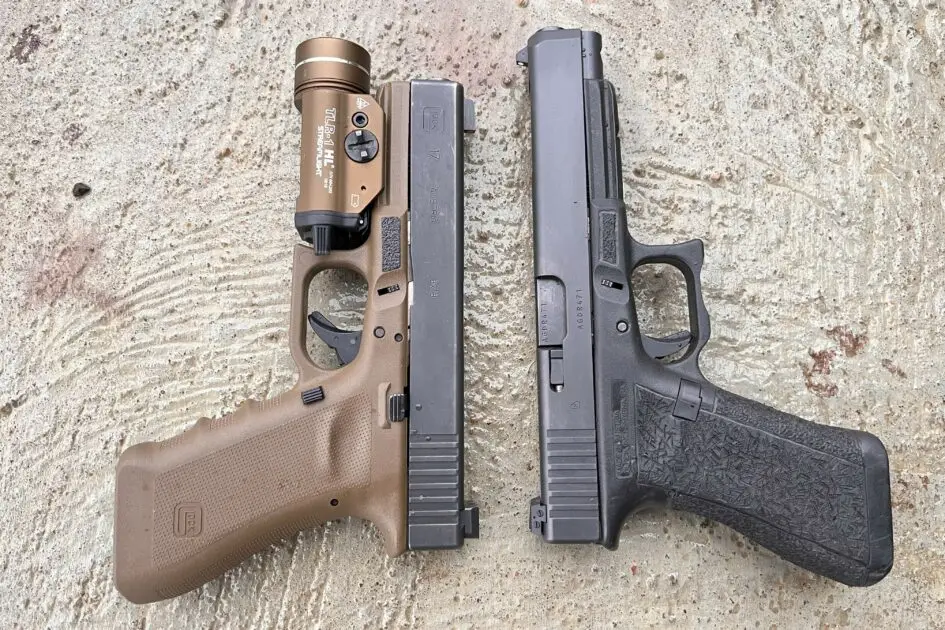

If you’ve spent any time at a match—USPSA, IDPA, Steel Challenge, or your local action-pistol league—you’ve seen the same question pop up again and again:
Should I run a Glock 34 or a Glock 17?
Both are proven, reliable, and supported by a massive aftermarket. Both can be competitive in the right hands. But they feel different on the clock, and they shine in different contexts. This guide breaks down the practical differences that matter to competition shooters—handling, speed, division fit, optics readiness, and how to choose based on your goals.
Quick answer: Which one should you choose?
- Choose the Glock 34 if you want the longest “factory-style” Glock that’s purpose-built for competition: longer sight radius, slightly softer tracking feel, and a configuration that’s popular for action-pistol games—especially with an optic.
- Choose the Glock 17 if you want the most versatile “do-it-all” platform: faster transitions for some shooters, easier division fit in certain rule sets, and a setup that can be competitive almost anywhere with minimal fuss.
Now let’s get specific.
Glock 34 vs Glock 17: Specs that matter (and why they matter)
On paper, the Glock 34 is basically a Glock 17 stretched for match performance. In the real world, those extra fractions of an inch can change how the pistol balances, tracks, and points when you’re pushing speed.


At-a-glance comparison table
| Feature | Glock 34 (Gen5 / 34 Gen5 MOS variants) | Glock 17 (Gen5 / 17 Gen5 MOS variants) |
|---|---|---|
| “Role” in competition | Long-slide match favorite | Full-size all-rounder |
| Barrel length | 5.31″ | 4.49″ |
| Feel on transitions | Slightly more “settled,” can feel slower for some | Often feels quicker left-to-right for some |
| Sight radius | Longer (helps some shooters call shots) | Shorter (still plenty usable) |
| Optics-ready options | Commonly purchased in MOS configuration | Also widely available in MOS configuration |
| Aftermarket support | Huge | Huge |
Those numbers are useful, but the real question is how they show up on match day.
Handling differences on the clock
1) Sight radius and shot-calling
Competition is a game of information. When your sight picture (or dot) tells you exactly what happened, you can leave sooner and stop wasting time “confirming” hits.
Glock 34 advantage: The longer slide generally gives you a longer sight radius with irons, which can make it easier to call shots and hold a more precise sight picture—especially at distance or on partial targets. This doesn’t automatically make you more accurate, but it can make accurate shooting feel more “readable.”
Glock 17 advantage: A shorter slide can feel more responsive for some shooters. If you naturally drive the gun hard between targets, the 17 can feel snappier in transitions—especially on stages with lots of wide arrays.
2) Balance, tracking, and recoil impulse
Here’s the simplest way to think about it:
- Glock 34: More slide length out front can make the gun feel like it tracks flatter (or at least “steadier”) as the sights return. Some shooters describe it as easier to keep honest during fast strings.
- Glock 17: Slightly shorter slide can feel livelier. For some, that means faster target-to-target movement. For others, it means the sight picture is a touch busier during rapid fire.
Neither is universally “better.” The winner is whichever one returns to the target for you without extra steering or correction.
3) Draw, presentation, and dot finding (if you run an optic)
If you’re running a dot, the difference becomes less about sight radius and more about:
- how consistently you present to the same index, and
- how quickly you see the dot without “searching.”
Both the 34 MOS and 17 MOS can be extremely competitive. The biggest performance gains usually come from consistent grip and presentation—not slide length. That said, many shooters feel the longer 34 gives them a slightly more stable “window” during fast shooting, while the 17 can feel quicker to steer between targets.
Division fit: USPSA and IDPA considerations
Before you buy, confirm the division(s) you actually plan to shoot. Rules change, and local clubs may have quirks—so always check current rulebooks and approved lists.
USPSA Production and Carry Optics
In USPSA, both the Glock 17 and Glock 34 are widely used. USPSA maintains a Production gun list and notes that MOS versions of approved pistols are approved as well. That makes both models common picks for Production and Carry Optics style setups (depending on your configuration and local match rules).
Practical takeaway: If you’re focused on USPSA and want a “match-leaning” Glock that many competitors already know how to tune and run, the 34 is a very safe bet. If you want maximum versatility across match types and training contexts, the 17 is hard to beat.
IDPA: watch barrel length and box fit
IDPA is more restrictive about what fits where, and the details matter.
For example, the Equipment Appendices specify a barrel length limit of 4 ⅜” or less for Compact Carry Pistol (CCP). That automatically rules out a Glock 17 (4.49″) and definitely rules out a Glock 34 (5.31″) in CCP.
Other divisions rely heavily on the IDPA box fit requirements and specific division equipment rules. If IDPA is your primary game, verify your intended division and confirm the pistol and configuration you want will comply—especially if you’re adding an optic, magwell-style parts, or extended base pads.
Practical takeaway: If IDPA is your main focus, the Glock 17 is generally the safer “full-size” starting point than a long-slide option, but you still need to confirm division requirements for your exact setup.
Performance categories: where each pistol shines
When the Glock 34 tends to shine
- Stages with distance: More “readable” sight picture with irons for many shooters.
- Fast shooting on tight targets: Some find the longer slide tracks more predictably during rapid strings.
- Dedicated match setup: If this pistol’s main job is competition, the 34 is built with that in mind.
When the Glock 17 tends to shine
- Stages with lots of transitions: Many shooters feel the 17 changes direction a bit quicker.
- Versatility across games: The 17 is widely used across training, matches, and general range work.
- “One gun, many roles”: If you want a single platform you can keep consistent year-round, the 17 is a classic.
Choosing based on your competition goals
Scenario A: “I’m new to competition and want the easiest path.”
If you’re new, the biggest gains come from fundamentals: grip, vision, trigger control, and stage execution—not the last 2% of hardware advantage.
Recommendation: Choose the Glock 17 if you want a forgiving, widely supported platform that feels neutral and easy to learn. You can always move to a 34 later once your preferences are clearer.
Scenario B: “I’m committed to matches and want a dedicated setup.”
If the pistol’s job is “competition, period,” then lean into match-friendly traits.
Recommendation: Choose the Glock 34. The longer slide and match reputation make it a common choice for competitors who want a purpose-driven feel.
Scenario C: “I’m going to run a dot and shoot faster divisions.”
With a dot, both can be excellent. Your decision should center on what you track best at speed and what you can present consistently.
Recommendation: If you prefer a steadier feel in recoil, consider the 34 MOS. If you prioritize quick steering between targets, consider the 17 MOS.
Smart, competition-friendly setup tips (without overcomplicating it)
You can spend a lot of money chasing small gains. Here are upgrades and choices that typically provide the biggest “on-the-clock” payoff while keeping things sensible.
1) Sights or optic: prioritize what you can see fast
- If you shoot irons, choose sights with a clean, high-contrast front and a rear notch you can track under speed.
- If you shoot an optic, pick something durable and commit to presentation reps so the dot appears automatically.
2) Trigger work: consistency beats “lightness”
For most shooters, the best trigger is the one that breaks predictably and resets consistently. If you upgrade, test thoroughly and confirm reliability with your match ammo and practice volume.
3) Mags and base pads: reliability first
Competition is not the place for finicky gear. Use proven magazines, keep them clean, and replace springs on a schedule if you shoot a lot.
4) Holster and belt: get stable, safe, and repeatable
Your draw is a skill, and your gear should make it repeatable. A stable belt setup and consistent holster position help you build a reliable drawstroke under pressure.
Training drills to help you decide (and get better either way)
If you can test both models—even briefly—run drills that reveal what each pistol does for you:
Drill 1: Transitions on wide arrays
Set up 3–5 targets spread wide. Run controlled pairs and observe how quickly you stop the gun and leave cleanly. Does one model feel easier to steer?
Drill 2: Doubles at distance
At 15–25 yards (or your range’s safe equivalent), shoot doubles on a small scoring zone. See which pistol gives you a clearer call and a more honest return.
Drill 3: Draw-to-first-shot
Record your draw with video if possible. Which pistol presents more naturally? Which one gives you a cleaner, more repeatable index?
After 2–3 practice sessions, your preference usually becomes obvious.
Cost, parts, and long-term ownership
One reason Glocks are so popular in competition is the ecosystem:
- easy-to-find parts,
- tons of holster options,
- simple maintenance, and
- a huge knowledge base from other shooters.
Between the 34 and 17, the total cost of ownership is usually similar. The bigger “cost” is deciding what you’re optimizing for:
- Glock 34: optimize for match feel and trackability.
- Glock 17: optimize for versatility and a neutral, do-everything platform.
FAQ: Glock 34 vs 17 for competition
Is the Glock 34 more accurate than the Glock 17?
In practical competition terms, both can be extremely accurate. The 34’s longer sight radius (with irons) may help some shooters aim and call shots more confidently, which can feel like an accuracy advantage.
Is the Glock 17 faster than the Glock 34?
Sometimes. The 17 may feel faster in transitions for some shooters because it’s slightly shorter. But “faster” depends on your grip, vision, and how you drive the gun between targets.
Which is better for USPSA?
Both are popular in USPSA-style competition. Many shooters choose the 34 as a dedicated match pistol, while many choose the 17 for its versatility. Verify division requirements and the current approved lists for your configuration.
Which is better for IDPA?
IDPA divisions have more equipment constraints. Check box fit and barrel-length requirements for your intended division. If IDPA is your main game, the 17 is often an easier full-size starting point than a long-slide model, but you must confirm rules for your exact setup.
Final verdict
If you want a purpose-driven match feel, a longer sight radius with irons, and a platform that’s extremely common in action-pistol competition, the Glock 34 is the classic choice.
If you want the most versatile full-size option—one that can be competitive across many match formats and also serves as a neutral, easy-to-learn platform—the Glock 17 is a perennial favorite.
The best pick is the one you can present consistently, track cleanly, and shoot confidently under match pressure. If possible, shoot a match with each before deciding. Your timer (and your scores) will tell you the truth.