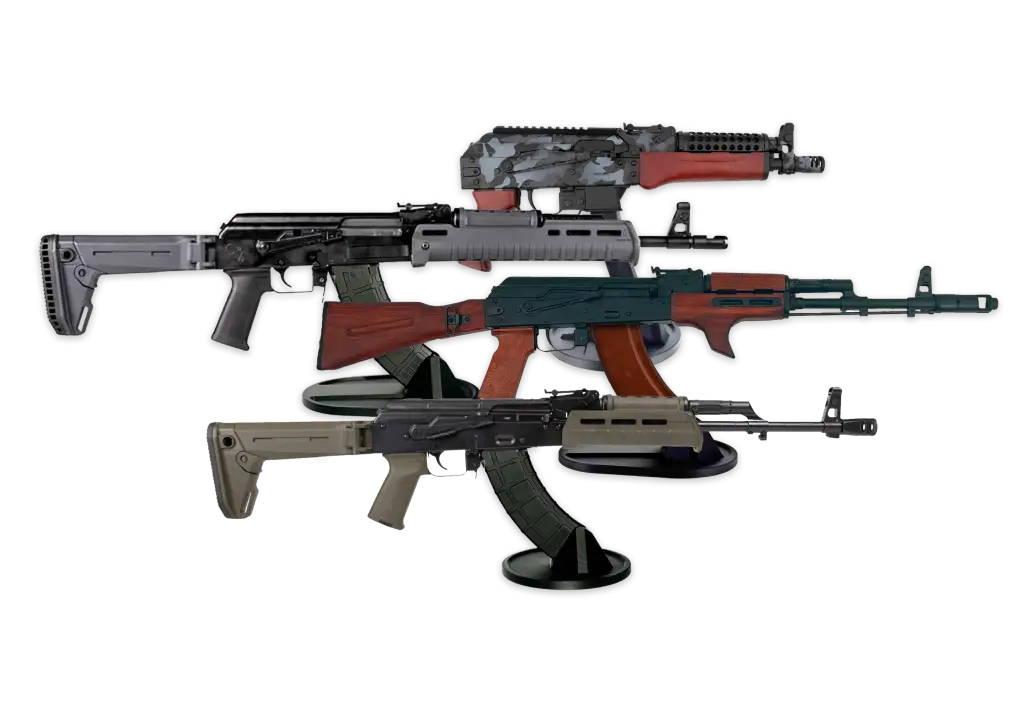
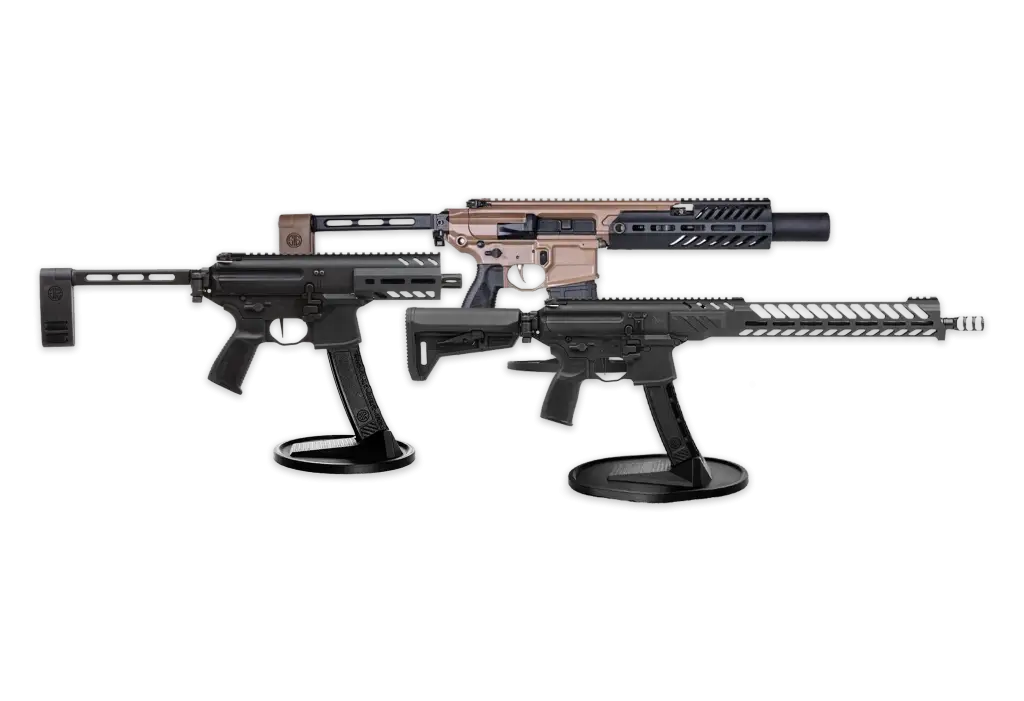
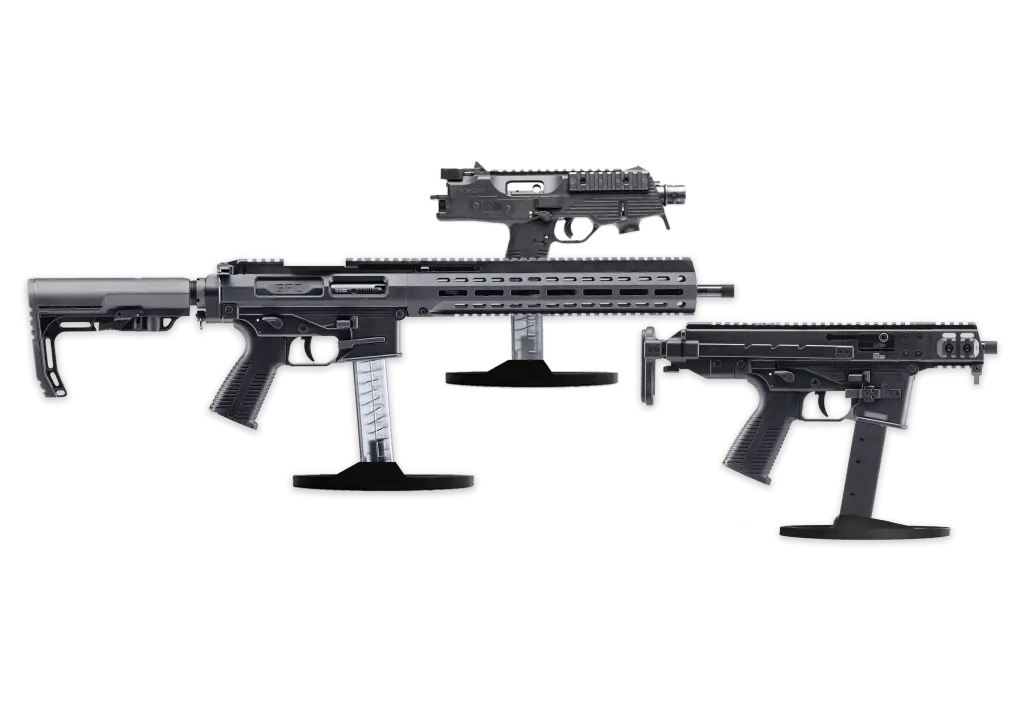
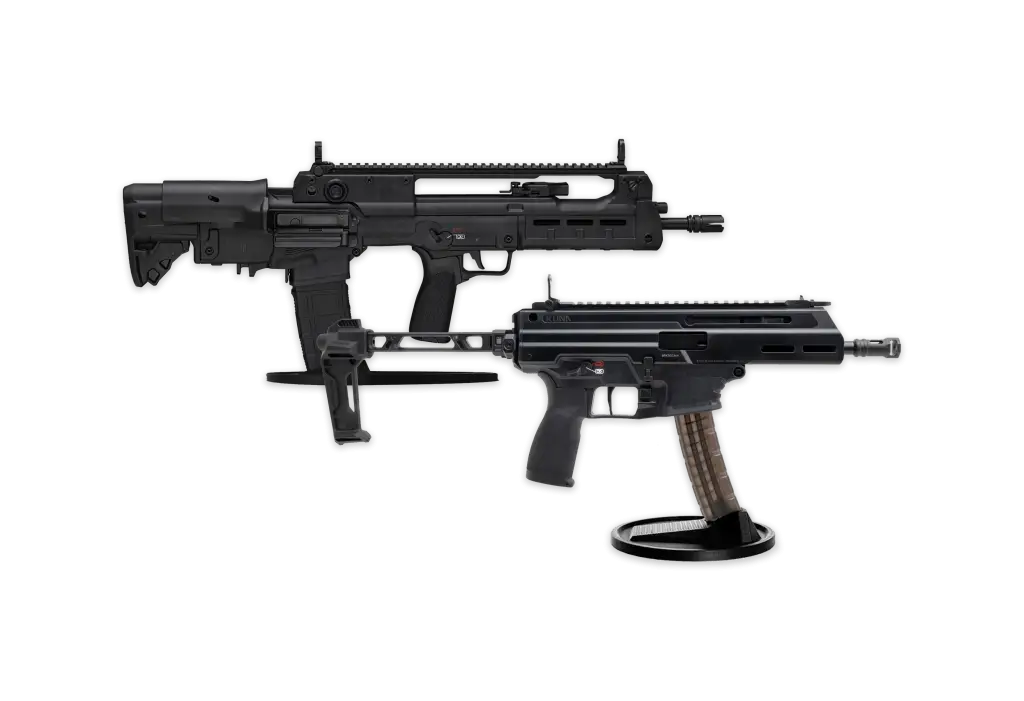







Modern AR-15 handguards are designed to do much more than protect the owner’s hands from barrel heat. They also provide mounting locations for lights, sling attachments, hand stops, grips, bipods, rail panels, and other compatible accessories. Two of the most recognizable modular attachment standards are M-LOK and KeyMod.
The M-LOK vs KeyMod comparison was once one of the most heavily debated topics in the AR-15 accessory market. Both systems were created to reduce the weight and bulk associated with traditional quad-rail handguards. They accomplish this by allowing owners to install accessories only where they are needed instead of covering every side of the handguard with permanent Picatinny rail.
Although both systems remain functional, M-LOK has become much more common across today’s rifle and accessory market. Understanding how each design works, where it came from, and how it compares with the alternatives can help owners identify their existing handguard and choose compatible accessories.
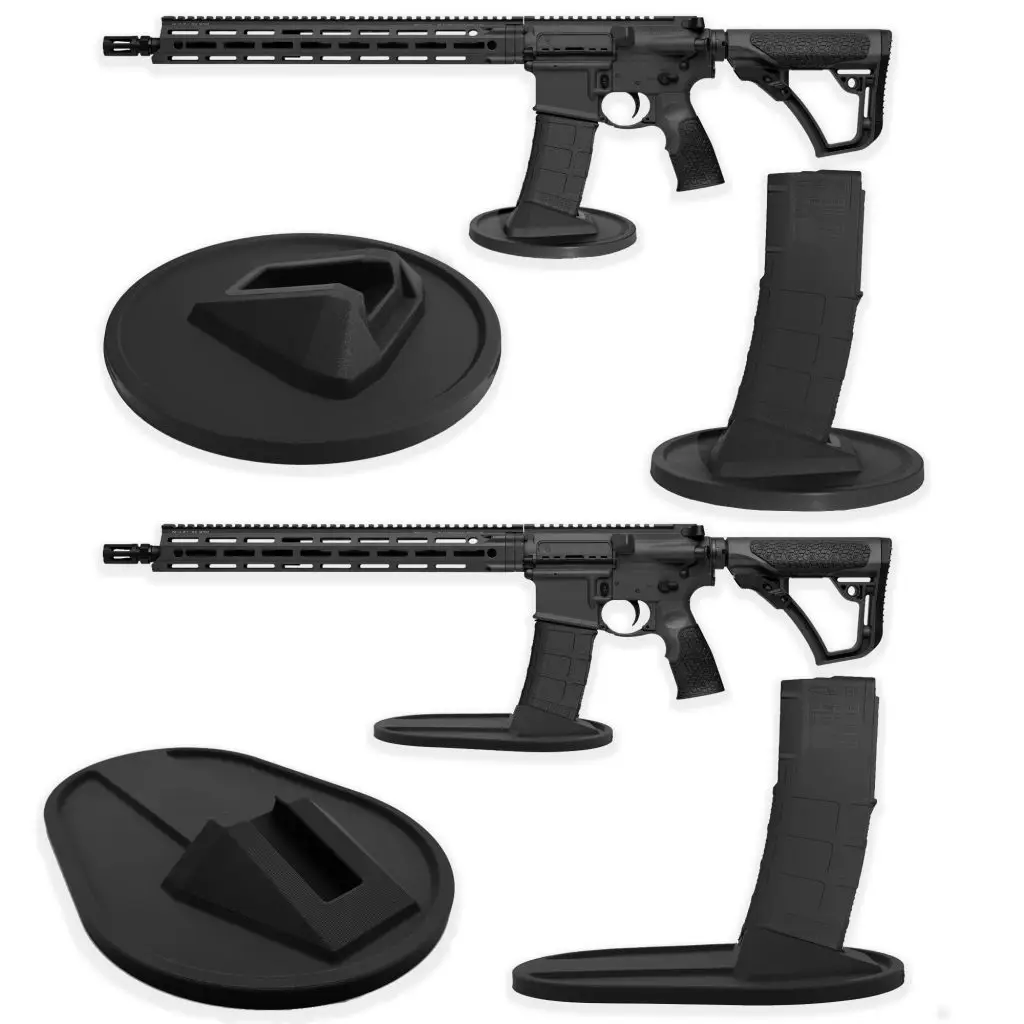
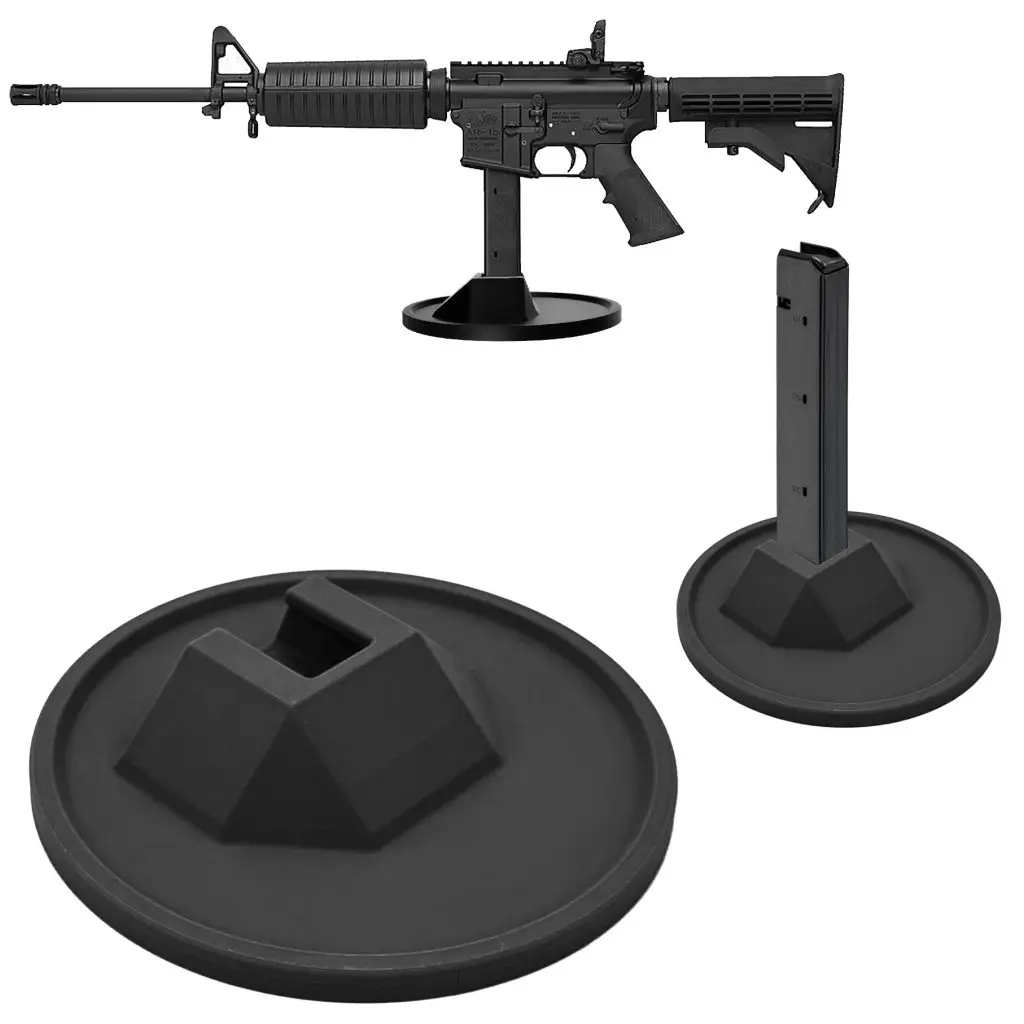
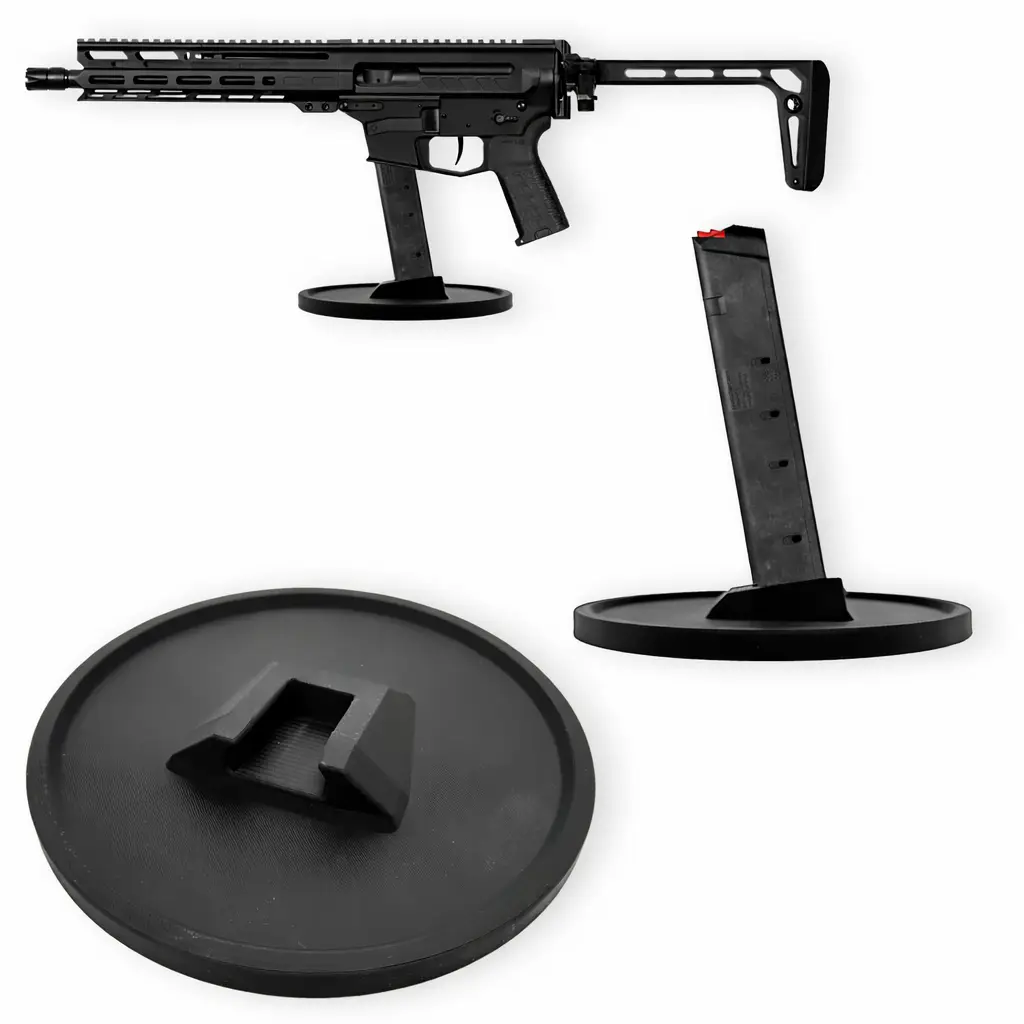
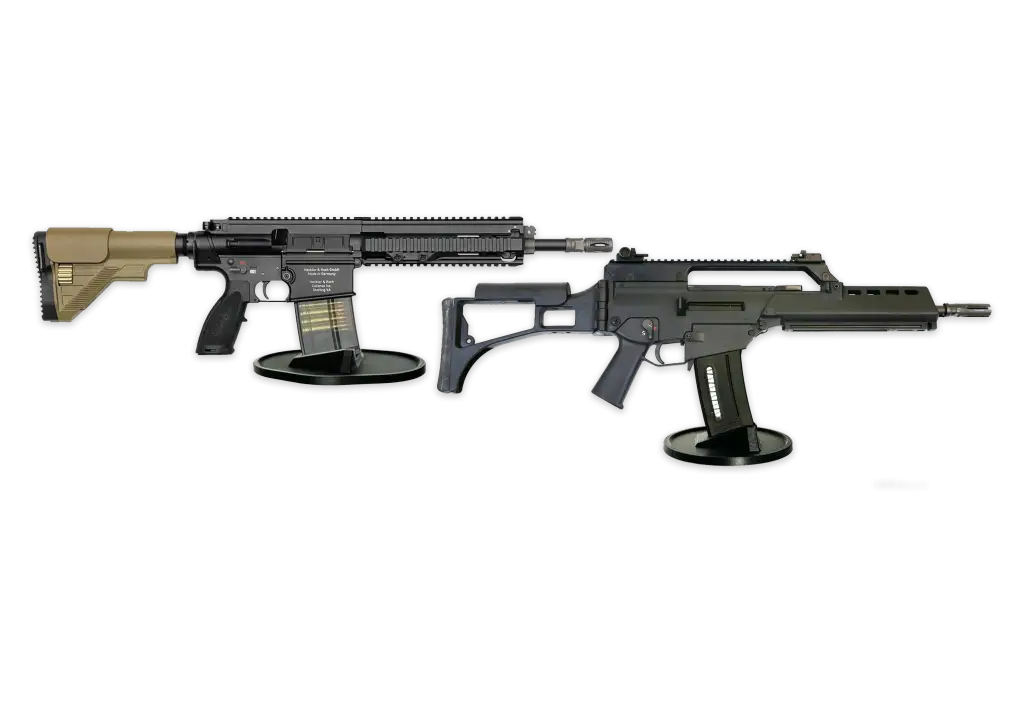
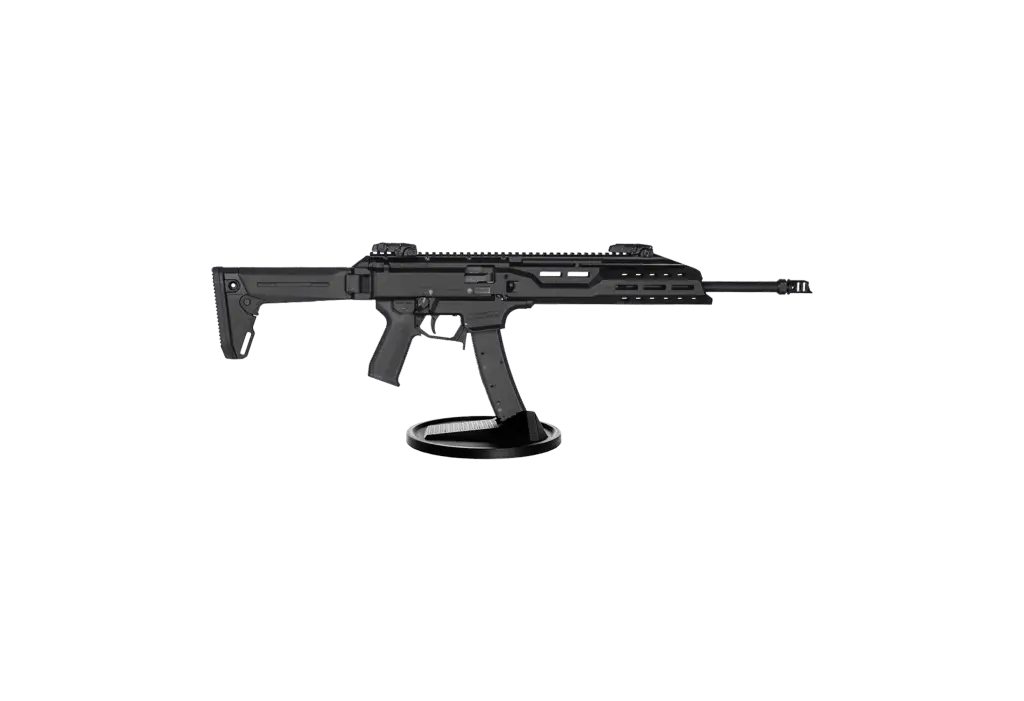
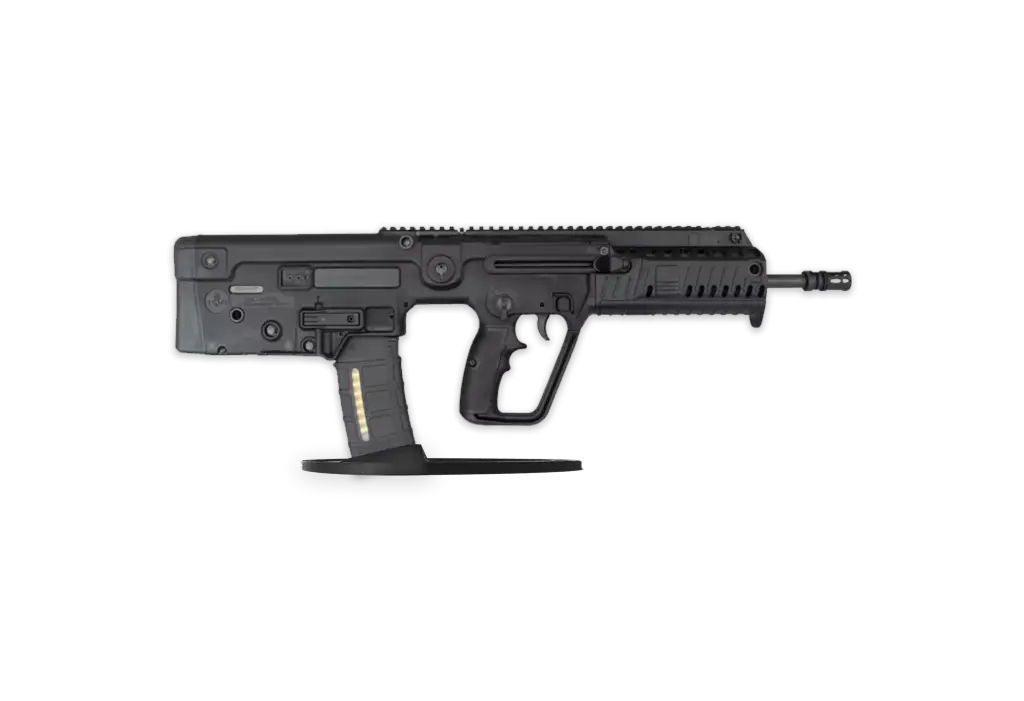
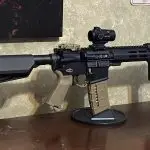
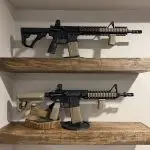
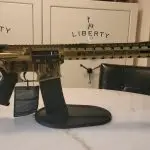
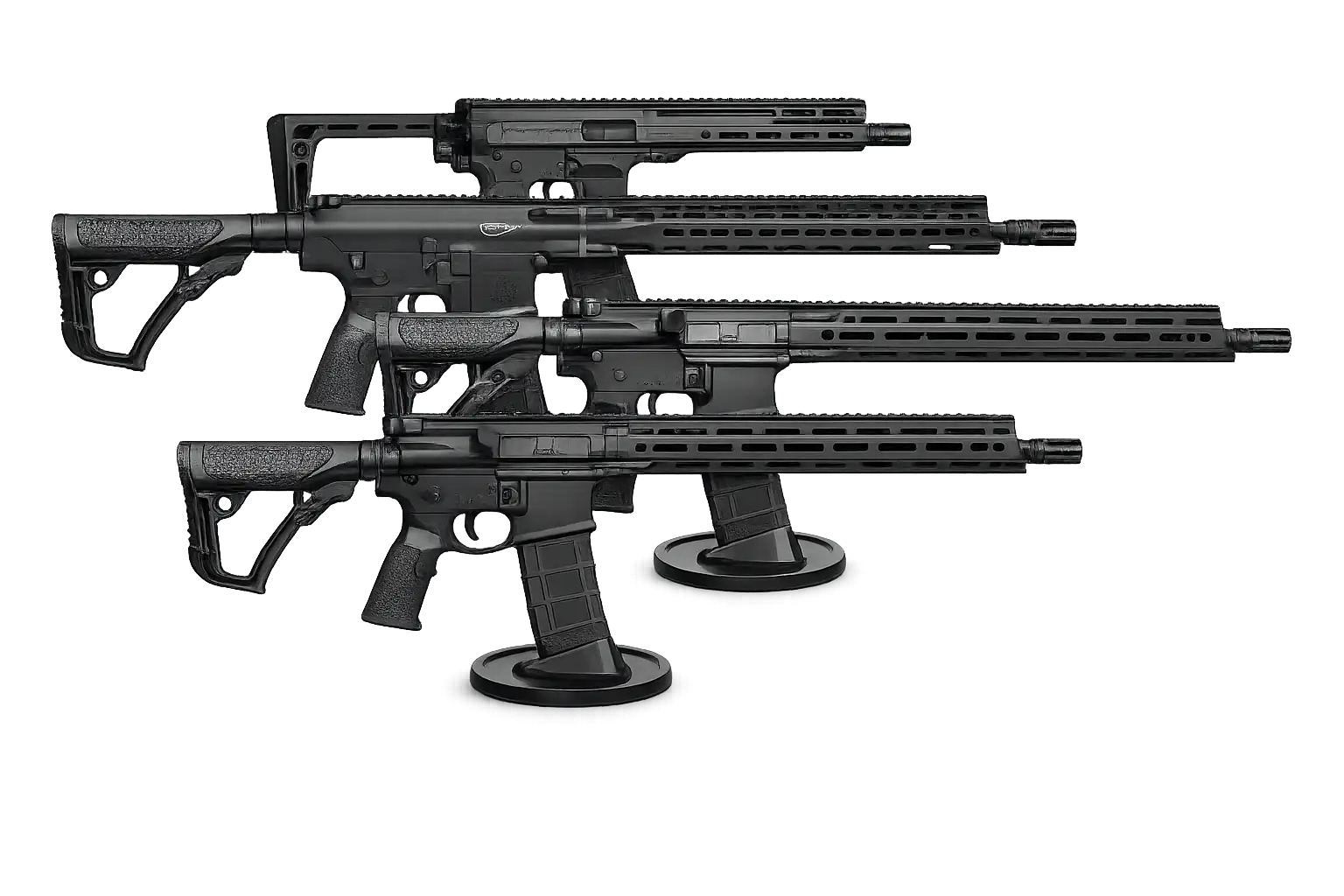
Once a rifle has been configured with the desired handguard and accessories, a magazine-compatible AR15 gun stand provides a clean way to showcase the complete build without covering the handguard.
What Is a Rifle Handguard?
A handguard is the component that surrounds much of a rifle’s barrel. Its basic purpose is to provide a gripping surface while reducing direct contact with the hot barrel and other internal components.
Depending on the design, a modern AR-15 handguard may also provide:
- Accessory mounting locations.
- Ventilation around the barrel.
- A continuous upper rail.
- Sling attachment points.
- Protection for the gas system.
- A stable support surface.
- A customized appearance.
Traditional handguards often offered few mounting options. Later quad-rail systems placed Picatinny rail on the top, bottom, and both sides. These rails provided extensive accessory space but could also increase weight, width, and surface bulk.
M-LOK and KeyMod were developed as slimmer alternatives.
What Is a Modular Handguard System?
A modular handguard uses slots or openings that accept compatible mounting hardware. Instead of having permanent rail sections along every surface, the owner can attach a short Picatinny section or a direct-mount accessory only where it is needed.
This approach can provide several advantages:
- Lower overall weight.
- A slimmer gripping surface.
- More flexible accessory placement.
- Less unused rail space.
- Improved ventilation.
- A cleaner appearance.
M-LOK and KeyMod use different slot shapes and mounting hardware, so accessories designed for one system generally cannot be mounted directly to the other.
What Is KeyMod?
KeyMod is a modular accessory attachment system that uses keyhole-shaped slots. The larger circular portion of each opening allows compatible mounting hardware to enter the handguard. The hardware then moves into the narrower section of the slot before being secured.
The recognizable keyhole pattern gives KeyMod its name.
Common KeyMod accessories have included:
- Picatinny rail sections.
- Sling mounts.
- Hand stops.
- Vertical grips.
- Angled grips.
- Light mounts.
- Bipod mounts.
- Rail covers.
KeyMod became popular during the early movement away from full quad rails. Its open specification allowed many manufacturers to produce compatible handguards and accessories.
What Is M-LOK?
M-LOK stands for Modular Lock. It is a modular attachment system developed by Magpul that uses elongated rectangular slots with rounded ends.
Compatible accessories use rotating T-nuts positioned behind the handguard slots. As the mounting screws are tightened according to the accessory manufacturer’s specifications, the T-nuts rotate and secure the attachment against the inside surface of the handguard.
M-LOK accessories commonly include:
- Direct-mount lights and light mounts.
- Quick-detach sling sockets.
- Hand stops.
- Vertical grips.
- Angled grips.
- Bipod mounts.
- Picatinny rail sections.
- Rail covers.
- Cable-management accessories.
M-LOK is now widely used on factory rifles, aftermarket handguards, stocks, forends, and accessories from numerous manufacturers.
How to Identify M-LOK and KeyMod
The easiest way to distinguish the two systems is by looking at the shape of the handguard openings.
M-LOK Appearance
M-LOK uses straight, rectangular slots with rounded ends. The slots often appear in rows along the sides and bottom of the handguard.
KeyMod Appearance
KeyMod uses openings shaped like old-fashioned keyholes. Each slot has a larger circular section connected to a narrower channel.
If the handguard uses keyhole-shaped openings, it is probably KeyMod. If it uses smooth rectangular slots with rounded ends, it is probably M-LOK.
The Origins of KeyMod
KeyMod emerged as one of the first widely adopted open modular handguard standards. It offered an alternative to heavy quad rails while giving accessory manufacturers a common attachment pattern to follow.
At the time, owners were increasingly searching for handguards that were:
- Lighter than quad rails.
- Thinner and easier to grip.
- Customizable.
- Compatible with direct-mounted accessories.
- Less covered in unused rail space.
KeyMod answered many of those demands and quickly appeared on handguards from numerous manufacturers.
The Development of M-LOK
Magpul developed M-LOK as an improvement over an earlier attachment concept used on some of its products. The system was designed to provide consistent mounting surfaces, secure hardware engagement, and compatibility with both metal and suitable nonmetallic products.
M-LOK was released as a licensed standard that manufacturers could adopt when following the required specifications. This encouraged broad industry support while preserving defined dimensional requirements.
As more manufacturers introduced M-LOK handguards and direct-mount accessories, the system became increasingly common on both complete rifles and aftermarket components.
M-LOK vs KeyMod Slot Design
The most obvious difference between M-LOK and KeyMod is the design of the mounting slots.
KeyMod hardware enters through the larger portion of a keyhole-shaped opening and moves into the narrower section. M-LOK hardware passes through a rectangular slot and is secured using a rotating T-nut behind the mounting surface.
Both approaches allow accessories to attach without a permanent full-length rail, but their hardware is not interchangeable.
| Feature | M-LOK | KeyMod |
|---|---|---|
| Slot shape | Rectangular with rounded ends | Keyhole-shaped |
| Typical hardware | Rotating T-nuts | KeyMod nuts or lugs |
| Direct accessory mounting | Yes | Yes |
| Picatinny sections available | Yes | Yes |
| Current market availability | Very broad | More limited |
M-LOK vs KeyMod Strength
Strength depends on more than the slot pattern alone. Handguard material, wall thickness, mounting hardware, accessory construction, installation quality, and the forces placed on the attachment can all influence performance.
M-LOK gained a major market advantage after comparative testing favored it in several areas, including repeatability and resistance to certain types of movement or loading. That testing contributed to wider institutional and commercial adoption.
This does not mean every KeyMod accessory is weak or unusable. Quality KeyMod components from reputable manufacturers can remain suitable for their intended purposes. However, M-LOK became the preferred standard for many manufacturers that wanted consistent performance across a broad accessory ecosystem.
M-LOK vs KeyMod Accessory Retention
Accessory retention describes how securely an attachment remains in position when the rifle is moved, transported, or subjected to ordinary use.
M-LOK’s rotating T-nut system creates clamping pressure against the inside of the mounting surface. When properly installed, the accessory is held against the outer face of the handguard.
KeyMod accessories use hardware that engages the narrower portion of the keyhole slot. Proper installation and compatible dimensions are important for secure engagement.
With either system, owners should:
- Use compatible hardware.
- Follow the accessory manufacturer’s instructions.
- Confirm that the mounting surface is suitable.
- Inspect attachments periodically.
- Avoid exceeding published specifications.
M-LOK vs KeyMod Weight
Both systems were designed to reduce unnecessary weight compared with full quad-rail handguards. Actual weight varies more by handguard construction than by slot pattern alone.
Factors that influence handguard weight include:
- Overall length.
- Material.
- Wall thickness.
- Barrel-nut design.
- Integrated upper rail.
- Number of slots.
- Reinforcement around mounting points.
- Included hardware.
A lightweight KeyMod handguard may weigh less than a heavily reinforced M-LOK model, and a lightweight M-LOK handguard may weigh less than a larger KeyMod design.
Buyers should compare the specifications of individual products rather than assuming one attachment standard is always lighter.
M-LOK vs KeyMod Handguard Diameter
Both systems support slimmer handguard profiles than traditional quad rails. Without permanent side and bottom rail sections, manufacturers can create narrower gripping surfaces.
A slimmer handguard may provide:
- A more natural grip for some owners.
- Less unnecessary material.
- Reduced exterior bulk.
- Easier access to mounted controls.
- A cleaner appearance.
The actual outside diameter still depends on the specific handguard. Some models are extremely narrow, while others provide additional internal clearance for larger barrel profiles, gas blocks, or other components.
Accessory Availability
Accessory availability is one of the biggest differences in the modern M-LOK vs KeyMod comparison.
M-LOK has become the more widely supported system. Major manufacturers currently offer extensive selections of M-LOK:
- Hand stops.
- Grip panels.
- Sling mounts.
- Light mounts.
- Vertical grips.
- Angled grips.
- Bipod attachments.
- Picatinny adapters.
- Cable-management products.
KeyMod accessories are still available, especially from established manufacturers and through existing inventory. However, the selection is generally smaller than it was during the system’s peak popularity.
Owners building a new rifle will usually find more choices with M-LOK.
Can M-LOK Accessories Fit KeyMod?
An M-LOK accessory generally cannot be mounted directly to a KeyMod handguard. The mounting slots and hardware use different designs.
Similarly, a direct-mount KeyMod accessory generally cannot be attached directly to an M-LOK handguard.
In some situations, an owner can install a compatible Picatinny rail section on the handguard and then attach a Picatinny accessory to that section. For example:
- An M-LOK-to-Picatinny rail section can be installed on an M-LOK handguard.
- A KeyMod-to-Picatinny rail section can be installed on a KeyMod handguard.
- A Picatinny-compatible accessory can then attach to the correct rail section.
This does not convert the entire handguard from one modular standard to the other. It simply provides a short universal rail interface for a compatible accessory.
What Is Picatinny Rail?
Picatinny rail uses a series of raised cross-slotted sections designed around a standardized profile. It remains one of the most widely recognized accessory-mounting systems.
Many modern M-LOK and KeyMod handguards include a continuous Picatinny rail along the top for mounting optics and sights. The sides and bottom then use modular slots to save weight and reduce bulk.
Picatinny rail remains valuable because it offers:
- Broad accessory compatibility.
- Defined mounting positions.
- Strong clamping surfaces.
- Extensive industry support.
Its primary disadvantages are additional weight, width, and the discomfort of gripping exposed rail sections without covers.
Quad Rail vs M-LOK and KeyMod
A quad rail usually provides Picatinny mounting surfaces at the top, bottom, and both sides of the handguard. This creates extensive attachment space but also places rail material in areas where accessories may never be installed.
Compared with many quad rails, modular M-LOK and KeyMod handguards are often:
- Lighter.
- Slimmer.
- Smoother to grip.
- Less bulky.
- More customizable.
Quad rails remain popular on historical reproductions, military-inspired builds, and rifles where maximum rail coverage is desired. They also provide a distinctive appearance associated with earlier generations of AR-15 development.
Free-Float M-LOK and KeyMod Handguards
Many M-LOK and KeyMod products use a free-float design. A free-float handguard attaches around the barrel nut and is designed to avoid direct contact with the barrel along most of its length.
This allows external pressure applied to the handguard to have less direct influence on the barrel than with some traditional systems.
Free-float handguards are popular because they can provide:
- Extensive accessory space.
- A continuous upper rail.
- Modern styling.
- Reduced unnecessary barrel contact.
- Multiple available lengths.
- Improved ventilation.
Both M-LOK and KeyMod are compatible with free-float designs. The attachment standard does not by itself determine whether a handguard is free-floating.
Drop-In Handguards
Some modular handguards use a drop-in design rather than a free-float arrangement. These products are intended to replace compatible two-piece handguards while retaining other portions of the existing assembly.
A drop-in handguard may offer a simpler appearance change or additional accessory mounting options without converting the rifle to a free-float system.
Compatibility depends on the rifle’s barrel length, gas-system length, front sight configuration, retaining hardware, and manufacturer specifications.
M-LOK on Durable Plastic Handguards
One important feature of M-LOK is that the standard can be incorporated into suitable durable plastic components as well as metal handguards.
This has allowed manufacturers to include M-LOK slots on:
- Traditional-style replacement handguards.
- Stocks.
- Shotgun forends.
- Rimfire accessories.
- Chassis systems.
- Other compatible platforms.
The ability to work across multiple materials helped M-LOK expand beyond aluminum AR-15 handguards.
Why M-LOK Became More Popular
M-LOK became the dominant modular handguard system for several connected reasons.
Broad Manufacturer Adoption
Rifle companies, handguard manufacturers, and accessory brands increasingly standardized around M-LOK.
Large Accessory Selection
As more M-LOK handguards entered the market, accessory companies produced more compatible grips, mounts, panels, stops, and adapters.
Testing and Evaluation
Comparative evaluations gave M-LOK an advantage in several performance categories and influenced major purchasing and manufacturing decisions.
Compatibility Across Materials
M-LOK could be incorporated into appropriate metal and durable plastic products, expanding its use across many equipment categories.
Factory Rifle Availability
Many complete rifles began shipping with M-LOK handguards, making it the default system for new owners.
These factors reinforced each other. More factory rifles created more accessory demand, and more available accessories encouraged additional manufacturers to adopt the standard.
Is KeyMod Obsolete?
KeyMod is no longer the leading modular attachment standard, but describing it as completely obsolete would be inaccurate.
Many KeyMod handguards and accessories remain in use. Owners who already have a quality KeyMod handguard may have no practical reason to replace it if it meets their needs and supports the accessories they want.
KeyMod may still make sense when:
- The rifle already has a compatible handguard.
- The desired accessories are available.
- The owner prefers its appearance.
- A quality handguard is available at an attractive price.
- The rifle is being kept in an era-specific configuration.
The main disadvantage is that future accessory selection may be more limited compared with M-LOK.
Is M-LOK Better Than KeyMod?
For most buyers choosing a new handguard today, M-LOK is generally the more practical option. It has broader industry support, a larger accessory market, and more factory-rifle adoption.
However, “better” depends on the specific product and intended use. A well-made KeyMod handguard can be preferable to a poorly manufactured M-LOK handguard. Construction quality, installation, barrel-nut design, alignment, material, and manufacturer support all matter.
M-LOK’s strongest advantages include:
- Greater accessory availability.
- More complete-rifle support.
- Broad manufacturer adoption.
- Compatibility with many direct-mount products.
- Strong long-term market position.
KeyMod’s remaining advantages may include lower prices on discontinued or existing products and personal preference for its distinctive slot design.
M-LOK vs KeyMod Appearance
Appearance is subjective, but the two systems create noticeably different visual styles.
M-LOK’s rectangular slots produce a clean, uniform appearance. Many modern handguards combine these slots with angled ventilation openings, smooth surfaces, and short rail sections.
KeyMod’s keyhole openings have a more mechanical and instantly recognizable look. Some owners prefer this pattern because it represents a particular period in the evolution of lightweight AR handguards.
For collectors, the attachment system can help visually identify when a rifle or handguard design became popular.
Available Handguard Lengths
M-LOK and KeyMod handguards have been produced in numerous lengths. Common examples include approximately:
- 7 inches.
- 9 inches.
- 10 inches.
- 12 inches.
- 13 inches.
- 15 inches.
- 17 inches.
Exact measurements vary by manufacturer. Handguard length should be selected according to the rifle’s barrel, gas system, muzzle components, intended configuration, and manufacturer recommendations.
Owners should not assume that a handguard’s marketed length is its exact measured length.
Handguard Materials
Modular handguards are produced from several materials.
Aluminum
Aluminum is commonly used for free-float handguards because it offers a useful balance of strength, weight, machinability, and corrosion resistance when properly finished.
Durable Plastic
Durable plastic is commonly used for replacement handguards, rail covers, grips, and other accessories. It can reduce weight and remain comfortable across changing temperatures.
Mixed-Material Designs
Some products combine an aluminum structural component with durable plastic covers, inserts, or accessory panels.
The attachment pattern does not determine the material. Both modular systems have appeared on aluminum products, although M-LOK has achieved broader adoption across different material types.
Choosing an M-LOK Handguard
When comparing M-LOK handguards, owners should consider more than appearance.
Important factors include:
- Handguard length.
- Outside diameter.
- Inside diameter.
- Overall weight.
- Barrel-nut design.
- Anti-rotation features.
- Top-rail alignment.
- Number and position of M-LOK slots.
- Integrated sling sockets.
- Manufacturer reputation.
- Installation requirements.
A handguard must also provide appropriate clearance for compatible internal components and the intended barrel configuration.
Choosing Accessories for an Existing KeyMod Handguard
Owners of KeyMod rifles should first determine which accessories they actually need. Replacing an entire handguard may be unnecessary if compatible products remain available.
Useful options may include:
- KeyMod Picatinny rail sections.
- Direct-mount sling sockets.
- KeyMod hand stops.
- Compatible grip panels.
- Direct-mount light attachments.
- KeyMod bipod mounts.
Product descriptions should be checked carefully because M-LOK and KeyMod versions of the same accessory may look similar in photographs while using completely different mounting hardware.
Common Buying Mistakes
Buying the Wrong Mounting Standard
One of the most common mistakes is ordering an M-LOK accessory for a KeyMod handguard or the reverse.
Assuming Every Slot Is M-LOK
Some handguards use proprietary ventilation openings that resemble accessory slots but are not designed for mounting equipment.
Ignoring Handguard Clearance
An attachment may fit the exterior slots while its hardware interferes with internal components or lacks adequate clearance.
Focusing Only on Weight
The lightest handguard is not automatically the best. Rigidity, mounting security, alignment, and durability also matter.
Buying Unnecessary Rail Sections
Many accessories can mount directly to M-LOK or KeyMod. Adding a Picatinny adapter where it is not needed can increase weight and push the accessory farther away from the handguard.
Direct Mounting vs Picatinny Adapters
A direct-mount accessory attaches straight to the modular slots. A Picatinny-compatible accessory requires a rail section to be installed first.
Direct mounting can provide:
- Lower weight.
- A lower accessory profile.
- Fewer separate components.
- A cleaner appearance.
Picatinny adapters can provide:
- Compatibility with existing rail-mounted accessories.
- Easier transfer between different rifles.
- More defined position adjustments.
- Support for accessories not available in a direct-mount version.
The better option depends on the accessory and how frequently it will be moved.
Maintaining a Modular Handguard
M-LOK and KeyMod handguards require relatively little routine maintenance, but they should still be inspected as part of normal rifle care.
Inspection may include:
- Checking for loose accessories.
- Inspecting mounting hardware.
- Looking for damaged slots.
- Cleaning dirt from ventilation openings.
- Inspecting the handguard’s attachment to the receiver.
- Following manufacturer maintenance instructions.
Any accessory that shifts, rattles, or fails to remain secure should be removed and inspected before continued use.
Display Considerations for Modern Handguards
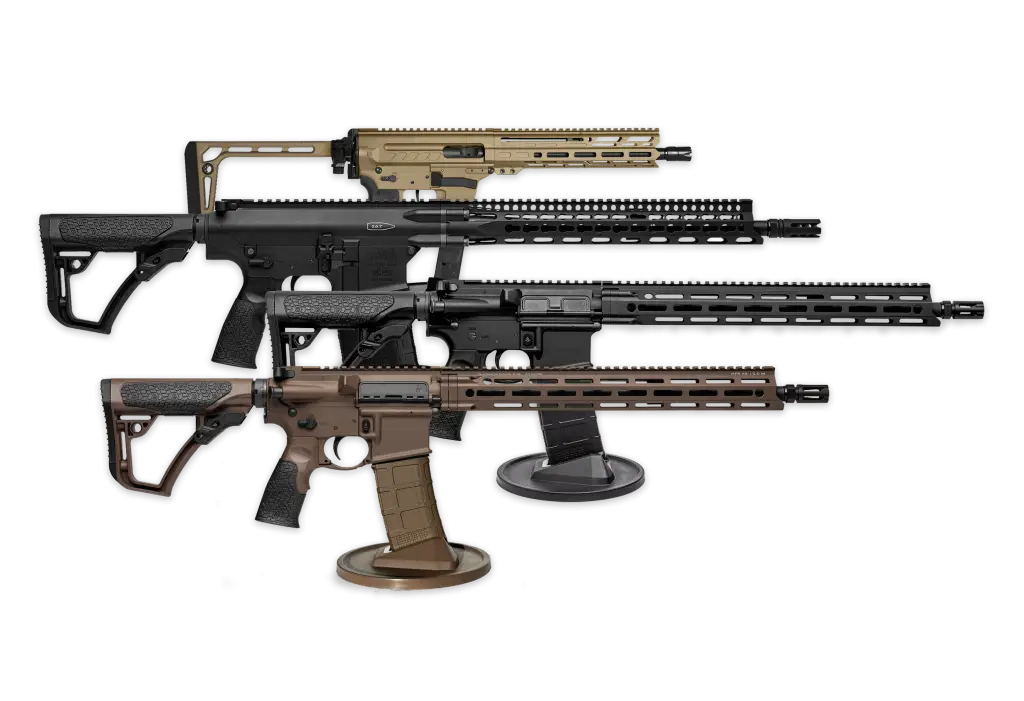
Handguards are often one of the most visually distinctive parts of a customized AR-15. Their length, slot pattern, finish, rail covers, grips, and mounted accessories can define the overall appearance of the rifle.
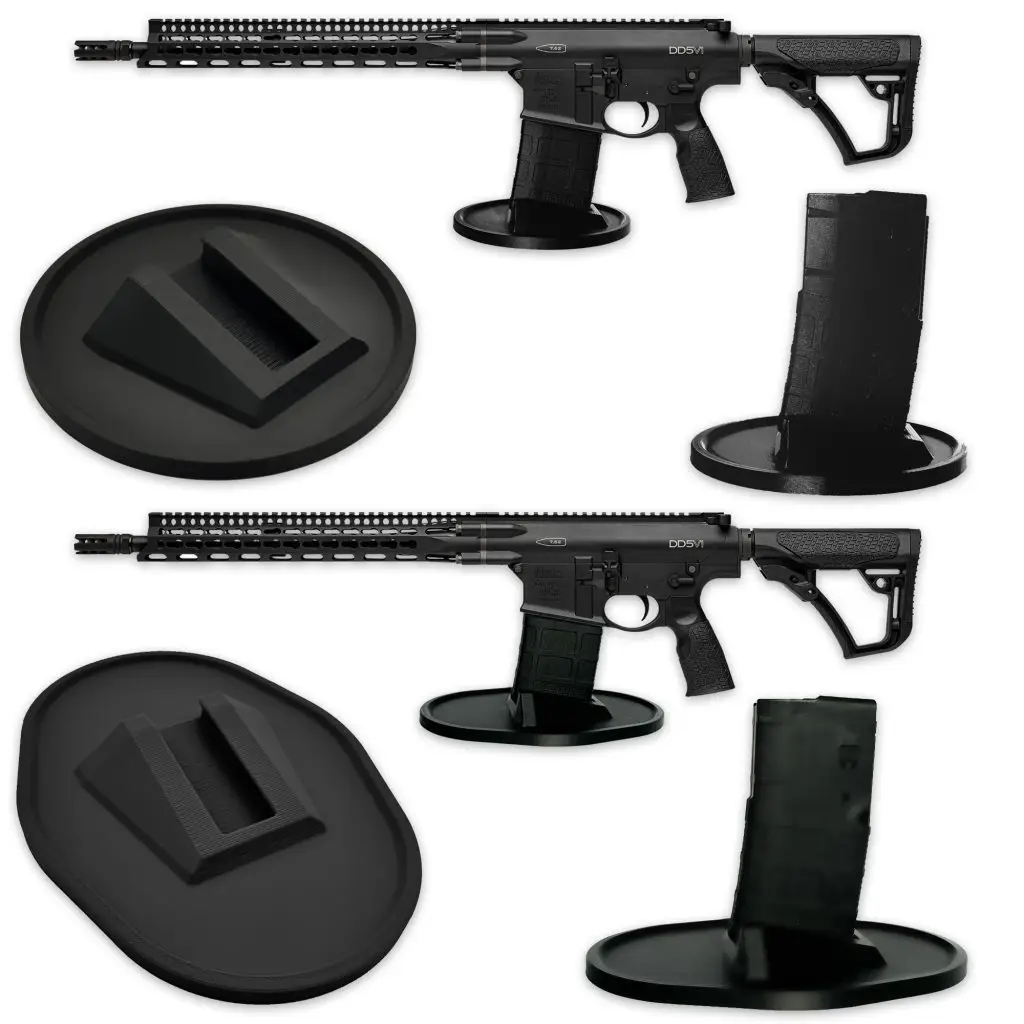
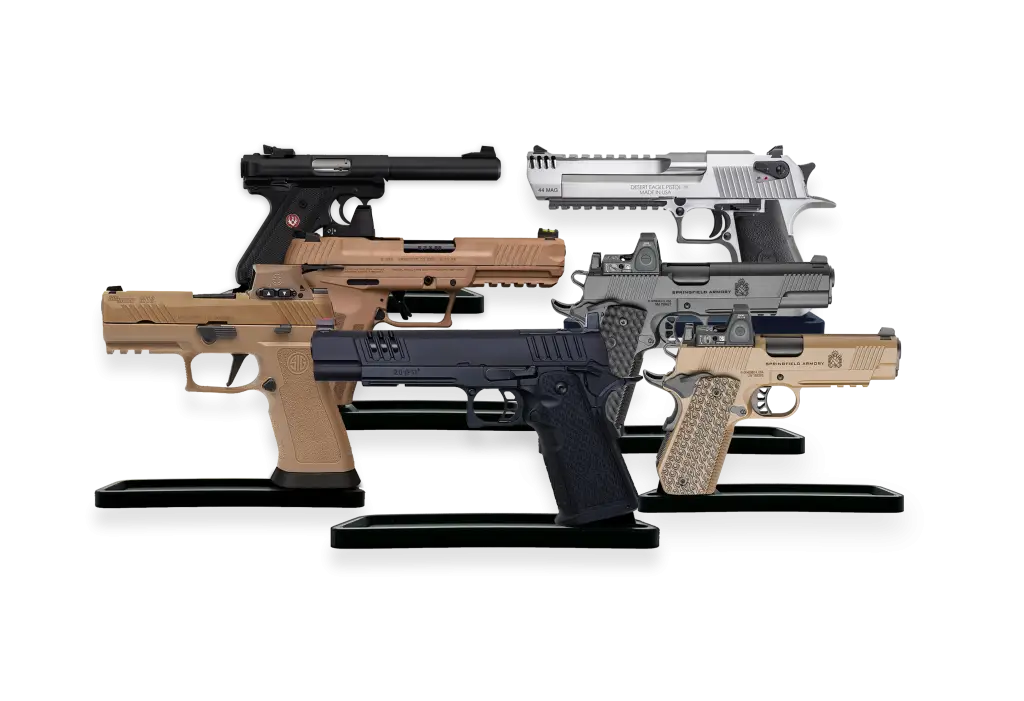
A conventional rack may contact or partially cover the handguard. A magazine-compatible rifle stand supports an appropriate rifle through a compatible magazine, allowing the handguard to remain visible.
This is especially useful for displaying:
- M-LOK handguards.
- KeyMod handguards.
- Classic quad rails.
- Retro handguards.
- Custom rail panels.
- Mounted lights.
- Hand stops and grips.
- Unique finishes and colors.
Why GunCreed Stands Work with Customized AR-15 Rifles
A customized rifle may include a premium handguard, optic, adjustable stock, upgraded grip, light, sling mount, and other carefully selected accessories. A display solution should highlight those components rather than hiding them.
GunCreed rifle stands use a compatible magazine to support the rifle through the magazine well. This creates a clean presentation while leaving the exterior configuration visible.
Benefits include:
- Minimal obstruction of the handguard.
- Clear visibility of mounted accessories.
- Professional collection organization.
- Easy comparison of different builds.
- A stable platform for product photography.
- Multiple available stand colors.
Whether a rifle uses M-LOK, KeyMod, or a traditional quad rail, a compatible gun stand helps showcase the features that make the configuration unique.
M-LOK vs KeyMod Frequently Asked Questions
Which Is More Popular: M-LOK or KeyMod?
M-LOK is currently much more common across factory rifles, aftermarket handguards, and accessory catalogs.
Can KeyMod Accessories Be Used on M-LOK?
Direct-mount KeyMod accessories generally cannot be installed directly on M-LOK slots. The systems require different hardware.
Can M-LOK Accessories Be Used on KeyMod?
Direct-mount M-LOK accessories generally cannot be installed directly on KeyMod handguards.
Can Both Systems Use Picatinny Accessories?
Yes. A compatible Picatinny rail section can be mounted to either system, allowing an appropriate Picatinny accessory to be attached.
Is M-LOK Lighter Than KeyMod?
Not necessarily. Total weight depends primarily on the individual handguard’s length, material, construction, and mounting hardware.
Should an Existing KeyMod Handguard Be Replaced?
Not automatically. A quality KeyMod handguard can remain useful if it is secure, undamaged, and compatible with the accessories the owner needs.
Which System Is Better for a New Build?
M-LOK is generally the more practical choice for a new rifle because of its larger accessory ecosystem and broad manufacturer support.
Final Thoughts
The M-LOK vs KeyMod comparison represents an important stage in the evolution of AR-15 handguards. Both systems were designed to reduce the weight and bulk of traditional quad rails while allowing accessories to be mounted only where needed.
KeyMod helped establish the modern modular-handguard market and remains functional on many existing rifles. Its recognizable keyhole-shaped slots supported a wide range of direct-mount accessories and lightweight handguard designs.
M-LOK uses rectangular slots and rotating T-nuts to secure compatible accessories. Broad manufacturer adoption, comparative testing, compatibility across multiple materials, and an extensive accessory selection helped it become the dominant modular attachment standard.
For most owners choosing a new handguard, M-LOK offers the strongest combination of accessory availability and long-term support. However, owners of quality KeyMod equipment do not necessarily need to replace it when it continues to meet their needs.
Whichever system is selected, component quality and compatibility matter more than the slot pattern alone. Owners should choose reputable products, follow manufacturer instructions, and verify that every accessory matches the handguard’s attachment standard.
After completing a rifle’s configuration, a durable AR15 gun stand provides an organized way to display its handguard, optic, stock, and accessories. Owners of larger-frame platforms can use a compatible AR10 gun stand to achieve the same clean presentation.